The “Corpse Bride” Mummified Daughter Ballroom Tale
— July 29, 2026Among the world’s strangest legends is the tale often called the “Corpse Bride” mummified…

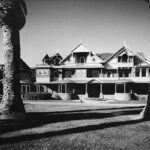
In San Jose, California, stands one of the most unusual homes ever constructed: the Winchester Mystery House. With its staircases that lead nowhere, doors that open into walls, windows overlooking interior rooms, and an astonishing number of rooms and hallways, the mansion has fascinated visitors for more than a century. At the heart of its legend is the story of an endless building project—one that supposedly continued day and night for decades because its owner believed that stopping construction would bring disaster.
The woman behind this extraordinary house was Sarah Winchester, widow of firearms magnate William Wirt Winchester, heir to the fortune created by the Winchester Repeating Arms Company. After the deaths of her husband in 1886 and her infant daughter years earlier, Sarah moved from Connecticut to California and purchased an unfinished farmhouse in the Santa Clara Valley. Over time, the modest structure grew into a sprawling mansion unlike any other.
According to popular legend, Sarah Winchester was haunted by the spirits of those killed by Winchester rifles. A spiritual advisor supposedly told her that she would be cursed unless she moved west and built a house that would continuously provide work for the spirits. The instructions were said to be that she must never stop building. If construction ended, the spirits would claim her life.
Whether this story is true remains uncertain. Much of what is known about Sarah Winchester comes from later accounts, newspaper stories, and promotional material created after her death. There is no definitive historical evidence proving that she actually believed she was being directed by ghosts. However, it is clear that she was deeply involved in the design and expansion of the house and that construction continued for decades.
From the late 1880s until Sarah Winchester’s death in 1922, workers reportedly built almost continuously on the property. The project expanded far beyond a typical residence. The mansion eventually contained approximately 160 rooms, including dozens of bedrooms, staircases, fireplaces, and hallways. At one point, the house covered around 24,000 square feet and included elaborate architectural details inspired by Victorian design.
The strange features of the home are what transformed it from an unusual mansion into a cultural phenomenon. Some staircases rise only a few feet before ending at ceilings. Others appear to have been built without a practical purpose. Doors open to blank walls or exterior drops. A staircase with unusually shallow steps was likely designed to accommodate Sarah Winchester’s small stature and mobility needs, but visitors often interpret such features as evidence of supernatural influence.
The endless construction also created a house that seems to defy ordinary architectural logic. Rooms were added, removed, or modified over time. Plans changed frequently, and some areas were rebuilt repeatedly. This constant evolution gave the house its famous maze-like quality. Rather than being designed as a single coherent structure, it became a physical record of decades of experimentation and alteration.
The 1906 San Francisco earthquake also affected the property. Several upper floors were damaged and later removed, leaving behind unusual transitions between sections of the house. The mansion’s final form was therefore shaped not only by Sarah Winchester’s choices but also by natural events and changing circumstances.
Despite the mystery surrounding her home, Sarah Winchester was not simply a recluse obsessed with construction. Historical accounts describe her as a businesswoman, philanthropist, and knowledgeable manager of her considerable wealth. She supported charitable causes and maintained a private but active life. The endless building project may have been influenced by many factors, including personal grief, creativity, privacy, and perhaps a desire to create something unlike anything else in the world.
After Sarah Winchester died in 1922, the house was sold and eventually opened to the public. Today, the Winchester Mystery House remains one of California’s most famous attractions. Visitors come not only to hear the ghost stories but also to appreciate the craftsmanship, the unusual architecture, and the mystery of a home that seems to have grown organically over time.
The true reason behind the endless construction may never be fully known. Was Sarah Winchester attempting to appease spirits, coping with personal tragedy, expressing artistic creativity, or simply building a private world of her own design? The uncertainty is part of what makes the Winchester Mystery House so captivating. It is not merely a strange building—it is a monument to imagination, mystery, and the enduring fascination humans have with the unexplained.
Among the world’s strangest legends is the tale often called the “Corpse Bride” mummified…
To modern readers, the idea of children’s toys containing lead sounds shocking, yet for…
In early December 1952, London was gripped by one of the most severe air…