The Anglo-Zanzibar War (1896): The Shortest War in History
— August 6, 2026When people think of famous wars, they often imagine conflicts that stretched across years…

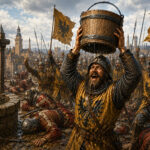
Few wars in history have a name quite as peculiar as the War of the Oaken Bucket. Fought in northern Italy in 1325, the conflict pitted the rival city-states of Bologna and Modena against one another. At first glance, it sounds like the sort of ridiculous medieval quarrel that might have begun when someone stole a humble wooden pail. The reality, however, was considerably more complicated—and considerably bloodier.
The two cities had been rivals for generations, caught up in the enormous political struggle between the Guelphs, who generally supported the papacy, and the Ghibellines, who supported the Holy Roman Emperor. Bologna was firmly aligned with the Guelphs, while Modena was associated with the Ghibelline cause. Their rivalry involved territory, political influence, castles, trade routes, and a great deal of mutual hostility.
By 1325, tensions had reached a boiling point. The immediate dispute involved Modena’s seizure of the Bolognese castle of Monteveglio, rather than a bucket. Bologna responded by mobilizing a large army against Modena. The famous bucket story appears to have been a later embellishment—or, at most, a trophy-taking episode associated with the conflict rather than its true cause.
The decisive confrontation came at the Battle of Zappolino on November 15, 1325. The Bolognese army vastly outnumbered the Modenese force. Contemporary and later accounts give differing figures, but the commonly cited estimates suggest that Bologna fielded roughly 30,000 infantry and 2,000 cavalry, while Modena had approximately 5,000 infantry and 2,000 cavalry. Despite this enormous numerical disadvantage, Modena won.
The battle itself was remarkably brief considering the size of the armies. After the Bolognese forces were defeated, the retreat became a rout, and the victorious Modenese pursued their enemies toward Bologna. The battle resulted in thousands of casualties and represented a major humiliation for Bologna.
And then there was the bucket.
According to the famous legend, Modenese soldiers had previously sneaked into Bologna and stolen an oak bucket from a city well. Bologna supposedly demanded its return, and when Modena refused, war followed. It is a wonderfully absurd story—but historians generally regard it as inaccurate. The more credible version is that the Modenese acquired the bucket after their victory, taking it from a Bolognese well as a trophy.
Whatever its original significance, the bucket became a permanent symbol of Modena’s triumph. It is still preserved in Modena today, while a copy is displayed in the city’s famous Ghirlandina tower. In other words, a rather ordinary piece of medieval equipment survived for nearly seven centuries because its owners decided it was a particularly satisfying souvenir of humiliating their neighbors.
The bucket’s fame grew dramatically centuries later thanks to Alessandro Tassoni, a poet from Modena. In 1622 he published La secchia rapita—The Rape of the Bucket—a mock-heroic poem inspired by the 1325 conflict. Tassoni transformed the old rivalry into a comic literary epic, exaggerating and inventing events for humorous effect. His poem helped cement the idea that the bucket itself had been the cause of the war.
The actual conflict was therefore much less ridiculous than its name suggests. Bologna and Modena were participants in the bitter political and territorial struggles that characterized medieval Italy. Thousands of men fought and died over power, territory, and political allegiance—not because someone happened to walk away with a bucket.
Yet the bucket is precisely why the episode remains so memorable.
Today, the War of the Oaken Bucket offers a wonderfully strange glimpse into medieval history. It demonstrates how genuine political and military conflicts can eventually become legends, jokes, and symbols of local pride. What began as a serious struggle between two powerful Italian city-states ultimately became remembered around the world for one extraordinarily ordinary object.
And the best part of the story may be that Modena still has the bucket.
When people think of famous wars, they often imagine conflicts that stretched across years…
History is filled with conflicts over land, resources, politics, and power. Some wars have…
In San Jose, California, stands one of the most unusual homes ever constructed: the…