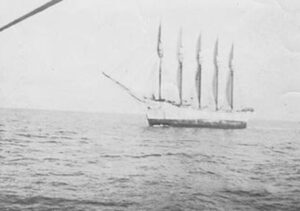
All Sails Set, No One Aboard: The Chilling Riddle of the Carroll A. Deering
— August 13, 2026In the misty pre-dawn hours of January 31, 1921, a Coast Guard surfman peering…

On the cold morning of September 8, 1863, along the rocky shoreline of Sandy Cove, Nova Scotia, a young boy stumbled upon a sight that would puzzle an entire province for the next fifty years. Slumped against a rock on the Bay of Fundy shore was a man — alive, but freezing, disoriented, and missing both of his legs, amputated cleanly just above the knee. Beside him sat a small stash of provisions: a loaf of bread, a tin of ship’s biscuits, and a jug of water. He would come to be known simply as Jerome, and to this day, no one has ever conclusively determined who he was, where he came from, or why he was left to die on a Nova Scotia beach.
According to most accounts, it was eight-year-old George “Collie” Albright who first spotted the stranger while walking the beach that morning. Other versions of the story credit local fishermen gathering rockweed with the discovery, but all agree on what they found: a young man, likely in his twenties or thirties, sitting upright against a large rock, clearly suffering from exposure after what must have been a brutal night in the cold. His legs had been amputated with obvious surgical skill, and the wounds, still bandaged, appeared fresh and only partially healed.
Word spread quickly, and the man was carried to the nearby home of the Albright family in the village of Digby Neck, where he was wrapped in blankets and given something warm to drink. It soon became clear that communicating with him would be no simple task. He did not respond to English or French, the two languages most common in the region, and villagers who tried Latin, Italian, and Spanish fared no better. He said almost nothing, though observers noted he seemed to understand at least some of what was happening around him. When repeatedly pressed for his name, he mumbled something that sounded to his rescuers like “Jerome” — and so that became the name history remembers him by.
Jerome’s arrival ignited immediate speculation throughout Digby County, and the mystery only deepened the longer he stayed. His hands were notably soft and free of calluses, suggesting he had never done manual labor — an odd detail for someone assumed to be a common sailor or laborer. His features struck locals as possibly Mediterranean. Theories multiplied over the following decades: some believed he was a sailor who had taken part in a failed mutiny and been punished by having his legs removed. Others speculated he was the heir to a fortune, deliberately maimed and abandoned so a rival could claim an inheritance in his place. Still others wondered if a blow to the head had left him permanently unable to process language, capable only of grunts and occasional animal-like sounds when startled.
Locals recalled that a ship had been seen lingering unusually close to shore in St. Mary’s Bay the day before Jerome was found, reinforcing the belief that he had been deliberately put ashore and abandoned — quite possibly to spare someone else the burden or cost of caring for him.
One of the more compelling theories to emerge decades later pointed across the Bay of Fundy to Chipman, New Brunswick. According to this account, a young foreign laborer working at a logging camp there had fallen through river ice around 1859 and developed severe gangrene in both legs, which a local doctor was forced to amputate. The man, believed to be Italian, became known locally as “Gamby” — likely a mishearing of gamba, the Italian word for “leg,” which he reportedly cried out upon waking from the surgery. As the cost of his care mounted, the town is said to have quietly arranged for a ship’s captain to take him away rather than continue supporting him. If that captain simply crossed the bay and left his passenger on the nearest convenient beach, it would neatly explain how “Gamby” of New Brunswick became “Jerome” of Nova Scotia. The theory remains unproven and has drawn its share of skeptics, but it endures as the most cited explanation for the mystery.
Whoever he was, Jerome would go on to live in the Digby Neck and Sandy Cove area for nearly fifty more years, passed between the homes of local families who took turns caring for him, eventually with a small weekly stipend from the Nova Scotia government to help offset the cost. He never learned to read or write, rarely spoke, and gave no further clues about his past, even as generations of curious visitors came calling, hoping he might finally break his silence. He died on April 15, 1912, taking whatever he knew about his own identity with him to the grave.
More than a century later, Jerome remains one of Atlantic Canada’s most famous unsolved mysteries — a haunting reminder of how a single, silent man washed up on a beach can become a legend that outlives everyone who ever met him.
In the misty pre-dawn hours of January 31, 1921, a Coast Guard surfman peering…
On July 26, 1184, one of the strangest and most gruesome mass-casualty events of…
In the winter of 1892, in the small farming village of Exeter, Rhode Island,…