The Man with No Name and No Legs: Nova Scotia’s Enduring Beach Mystery
— August 12, 2026On the cold morning of September 8, 1863, along the rocky shoreline of Sandy…

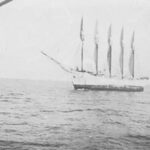
In the misty pre-dawn hours of January 31, 1921, a Coast Guard surfman peering through a telescope from the Cape Hatteras Life-Saving Station spotted something that looked almost unreal: a magnificent five-masted schooner, every sail still set and full, run hard aground on the notorious Diamond Shoals off North Carolina’s Outer Banks. It would take rescuers four more days to reach her through violent seas. When they finally climbed aboard, they found no captain, no crew, and no clear answer to what had happened — only the beginning of one of the most enduring maritime mysteries in American history.
The Carroll A. Deering was no ordinary vessel. Built in 1919 in Bath, Maine, by the G. G. Deering Company, she stretched 255 feet long and was among the last great wooden cargo schooners ever constructed before steel ships made the design obsolete. She had set sail from Norfolk, Virginia, in August 1920, bound for Rio de Janeiro, Brazil, with a cargo of coal, and was on her return voyage north when things began to go wrong.
In early January 1921, while stopped in Barbados, Captain Willis B. Wormell reportedly confided to a friend, fellow captain G. W. Bunker of Maine, that his crew was the most unruly he had encountered in his long career. Wormell had actually taken on a replacement crew for this voyage after his original first mate fell ill, and tension aboard the ship seems to have simmered for weeks.
On January 29, as the Deering passed the Cape Lookout lightship off the North Carolina coast, a crew member hailed the lightship through a megaphone, reporting that the ship had lost both anchors and chains in a storm and asking that the message be passed along to the ship’s owners. The lightship keeper, Captain Thomas Jacobson, later gave an unsettling account: the man who called out was tall, thin, and red-haired, spoke with a rough accent, and didn’t carry himself like an officer at all. Jacobson also noticed the crew scattered loosely about the quarterdeck — the captain’s traditionally sacrosanct space — behaving in a way that struck him as strange and undisciplined. Because his radio was broken, Jacobson couldn’t relay the anchor-loss message, and the Deering sailed on into the darkness.
Two days later, she was found aground and utterly deserted on Diamond Shoals.
What investigators discovered when they finally boarded the wrecked schooner only deepened the mystery. The galley stove still held food — coffee and soup on the burners, spareribs sitting in a pan — as though the crew had been interrupted mid-meal. Yet the captain’s cabin was in disarray, and the ship’s navigational instruments, logbook, and all of her lifeboats were missing. There wasn’t a single body, and not a single survivor was ever found.
The prevailing theory at the time, voiced bluntly by Coast Guard Captain R. L. Gaskill, was straightforward: caught on the shoals in ferocious winds and towering waves, the crew likely panicked, launched the lifeboats, and tried to row roughly nine miles to shore — a desperate gamble that no boat could have survived in such punishing seas. Gaskill dismissed talk of piracy as “so much newspaper bunk.” It was a plausible, almost mundane explanation for a disappearance that the public was determined to find sinister.
And sinister explanations came pouring in. This was, after all, the height of Prohibition, and rum-running was rampant along the Atlantic coast — leading some to speculate the crew had been involved in smuggling and either fled or were eliminated by criminal associates. Others pointed to reports of unusual ship traffic near the Deering in her final days and floated theories of piracy or mutiny. Wilder rumors even invoked lingering wartime paranoia about rogue German U-boats, though the war had ended more than two years earlier.
Adding fuel to the fire, a corked bottle later washed ashore on a North Carolina beach containing a note, purportedly from a crew member, claiming the ship had been seized by pirates. The message caused a genuine stir in international shipping circles and briefly convinced investigators they were dealing with a genuine act of piracy on the high seas — though the bottle’s authenticity was later called into serious question, and some researchers now believe it was a hoax.
The case wasn’t allowed to quietly fade away. Captain Wormell’s daughter pushed hard for a full federal investigation, and her efforts drew the attention of the U.S. Department of Justice, the Coast Guard, the Department of Commerce, and even the State Department — along with a young Secretary of Commerce named Herbert Hoover, who would go on to become President. Despite months of inquiry, agencies combing through shipping records, crew backgrounds, and rumors of smuggling rings, no definitive answer ever emerged. No trace of Captain Wormell or his crew was ever found.
More than a century later, the Carroll A. Deering remains unsolved. The most sober explanation — a doomed attempt to escape a wrecked ship in monstrous seas — is also the most likely, but it has never been definitively proven, and it doesn’t fully account for the strange crew behavior reported before the wreck or the vanished logbook and instruments. That gap between the mundane and the impossible is exactly what has kept the story alive for over a hundred years, inspiring books, documentaries, and a permanent place among the great unsolved maritime mysteries of the twentieth century.
Today, the Carroll A. Deering is remembered not just as a shipwreck, but as America’s own “Flying Dutchman” — a vessel found perfectly intact, sails full, dinner on the stove, and not a single soul left to explain why.
On the cold morning of September 8, 1863, along the rocky shoreline of Sandy…
On July 26, 1184, one of the strangest and most gruesome mass-casualty events of…
In the winter of 1892, in the small farming village of Exeter, Rhode Island,…