All Sails Set, No One Aboard: The Chilling Riddle of the Carroll A. Deering
— August 13, 2026In the misty pre-dawn hours of January 31, 1921, a Coast Guard surfman peering…

For more than three centuries, one of the strangest psychological afflictions in European history convinced sufferers, from peasants to princes, that their bodies were made of fragile, breakable glass. No case of this so-called “glass delusion” is more famous, or more thoroughly documented, than that of Charles VI of France — a king whose descent into madness would help plunge his kingdom into decades of civil war and foreign invasion.
Charles VI ascended the French throne in 1380 at just eleven years old, following the death of his father, Charles V. Too young to rule in his own right, the boy king was effectively sidelined by four powerful uncles — the Dukes of Anjou, Berry, Burgundy, and Bourbon — who governed in his name while helping themselves generously to the royal treasury. When Charles finally came of age and took the reins of government himself, he ruled well enough in his early years to earn the affectionate nickname “Charles the Beloved.” No one could have predicted the nickname that would eventually replace it: “Charles the Mad.”
The turning point came in August 1392. Charles, then twenty-three, was leading a company of knights through a forest near Le Mans on a military campaign against the Duke of Brittany. According to chroniclers, a disheveled man suddenly emerged from the trees, grabbed the king’s bridle, and warned him that he was riding into betrayal. Guards pulled the man away, but he reportedly continued shouting his warning as the procession moved on, and the king’s nerves were clearly rattled.
Later that day, in the heat and dust of the march, a page boy accidentally dropped a lance. The sudden clang of metal apparently shattered whatever fragile composure the king had left. Charles drew his sword and turned on his own men, screaming that traitors were trying to deliver him to the enemy. By the time his companions managed to wrestle him from his horse and disarm him, he had killed at least one of his own knights and wounded several others. He then collapsed into a stupor that lasted two full days, waking with no memory of the massacre he had caused.
It was the first of what would become a lifetime of recurring psychotic episodes — periods in which Charles experienced violent paranoia, hallucinations, memory loss, and an inability to recognize even his own wife and children.
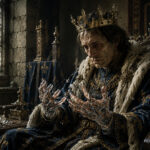
Among Charles’s many strange symptoms during his worst episodes, one became particularly infamous: his conviction that his body was made of glass. Convinced he might shatter at the slightest touch, he reportedly had metal rods sewn into his clothing to reinforce his limbs and torso, refused to let people come near him, and took extreme precautions against any accidental bump or fall. During these spells, he was also said to go months without bathing or changing his clothes, and to suffer bouts of severe paranoia, at times believing his own family intended to poison or replace him.
Strikingly, Charles was not alone in this specific delusion. Between the fifteenth and seventeenth centuries, physicians and philosophers across Europe documented a surprising number of similar cases, mostly among the upper classes. Sufferers believed various parts of their bodies — heads, arms, even entire torsos — had turned to glass, and the phenomenon was taken seriously enough to be discussed by major thinkers of the era, including René Descartes. Miguel de Cervantes even built a short story around the affliction. Historians still aren’t entirely certain why the delusion appeared so frequently in this particular period, though some point to the era’s philosophical preoccupation with the human body as a fragile, temporary vessel for the soul, awaiting eventual resurrection or dissolution.
Charles’s affliction was compounded by other traumas. In 1393, during a masquerade now remembered as the “Bal des Ardents,” or Ball of the Burning Men, Charles and five companions dressed in flammable costumes of tar-soaked flax to resemble wild men. A stray spark set the costumes ablaze, and four of the men burned to death in front of the horrified court. Charles survived, but the episode left him even more psychologically fragile.
As Charles’s periods of lucidity grew shorter and his episodes of madness more frequent and severe, a dangerous power vacuum opened at the heart of French government. His younger brother, the Duke of Orléans, and his cousin, the Duke of Burgundy, each maneuvered to fill it, and their rivalry eventually erupted into open, bloody civil war between the Armagnac and Burgundian factions. With France’s leadership in disarray, the kingdom became dangerously vulnerable just as the Hundred Years’ War with England reignited — a vulnerability the English crown, under Henry V, would exploit devastatingly at the Battle of Agincourt in 1415.
Charles VI died in 1422, having spent roughly three of his four decades on the throne cycling in and out of madness. His reign is remembered today as a case study in how profoundly the health of a single ruler could shape the fate of an entire nation. Behind the strange and almost darkly comic image of a king wrapped in iron rods, terrified of shattering like a windowpane, lies a genuinely tragic story: a man plagued by an illness no one in his era understood, ruling a kingdom that could not survive the chaos his condition unleashed.
In the misty pre-dawn hours of January 31, 1921, a Coast Guard surfman peering…
On the cold morning of September 8, 1863, along the rocky shoreline of Sandy…
On July 26, 1184, one of the strangest and most gruesome mass-casualty events of…