The King Who Thought He Would Shatter: The Strange Madness of Charles VI of France
— August 14, 2026For more than three centuries, one of the strangest psychological afflictions in European history…

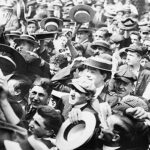
In September 1922, the streets of New York City erupted into eight days of genuine mob violence over what seems, by any modern standard, like the most trivial possible cause: men wearing the wrong hat at the wrong time of year. Roving gangs of teenagers beat strangers, smashed thousands of straw hats in the gutters, stopped traffic on the Manhattan Bridge, and even turned on police officers — all in the name of enforcing an unwritten fashion rule that carried no legal weight whatsoever. It is one of the strangest, and strangely underappreciated, riots in American history.
To understand why a hat could spark a citywide brawl, it helps to understand just how seriously early twentieth-century society took the seasonal hat calendar. Straw hats — most commonly the stiff-brimmed “boater,” originally associated with boating and rowing culture, along with the softer Panama hat — were considered acceptable summer headwear for men, including businessmen, in major American cities. But this privilege came with strict, unofficial boundaries. Straw hat season traditionally opened around May 15 and was expected to end by September 15, a date popularly nicknamed “Felt Hat Day.” Anyone still sporting a straw hat after that date was, by the informal etiquette of the era, fair game for public mockery — or worse.
This wasn’t purely folklore. On Wall Street, stockbrokers had developed something of a lighthearted ritual around the changeover, playfully smashing one another’s straw hats right on the trading floor each September 15 to mark the occasion. It was meant as good-natured fun among men who could easily afford a replacement. Unfortunately, that same impulse, filtered down through the city’s poorer and rougher neighborhoods, would prove considerably less good-natured when acted out on strangers who couldn’t necessarily afford a new hat at all.
The riot didn’t even wait for the actual deadline. On the evening of September 13, 1922, two days before the unofficial cutoff, groups of teenage boys in the old Mulberry Bend section of Manhattan decided to get a head start. They began snatching straw hats off the heads of local factory workers and stomping them into the pavement — a prank they had likely seen or heard about from previous years, escalated with the enthusiasm of a mob.
The trouble might have stayed a minor neighborhood nuisance if the boys hadn’t tried the same trick on a group of dockworkers. Unlike the factory workers, the dockworkers fought back, and what began as harassment turned into a full brawl. The fighting grew so intense that it spilled onto the Manhattan Bridge and brought traffic there to a standstill. Police were called in to break it up, and several arrests followed — but the disturbance had only just begun.
Over the following nights, the chaos spread across Manhattan and into Harlem, growing more organized and more dangerous. Some accounts from the time describe roving gangs numbering in the hundreds, even claims of crowds approaching a thousand, moving down avenues like Amsterdam Avenue and forcing straw-hatted men to run a gauntlet of hat-snatching and beatings. Boys armed themselves with sticks, some reportedly fitted with nails, specifically designed to hook hats off people’s heads from a distance. Men who tried to defend themselves or their hats risked serious injury; newspapers of the day reported that one man, twenty-five-year-old Harry Gerber, was beaten badly enough to require hospitalization, and another man was rumored to have lost an eye in the fighting.
Police officers were not spared either. Outnumbered and caught off guard by the scale of the unrest, several officers had their own hats snatched and destroyed while attempting to break up the crowds, and at least one detective was reportedly knocked into a gutter while chasing down offenders. Whenever authorities managed to disperse a gang in one neighborhood, another would simply reform blocks away, making the unrest maddeningly difficult to contain.
Curiously, the riot proved to be excellent business for the city’s hat shops. Merchants kept their stores open late into the night so that terrified straw-hat wearers could rush in and swap their now-dangerous headwear for softer felt hats, which were not a target of the mobs.
Many of the young rioters were under fifteen years old and therefore too young to be formally charged, so police instead delivered them straight to their parents — several boys were reportedly spanked on the spot at local station houses as punishment. Older offenders fared differently, facing night court before a magistrate whose surname, by an almost too-perfect coincidence, was Peter Hatting. Hatting handed down fines and short jail sentences to those convicted, reportedly declaring that hat-smashing was against the law and that a man had every right to wear whatever hat he pleased, regardless of the calendar.
By the time the unrest finally died down after about eight days, dozens of people had been injured and numerous arrests had been made, though remarkably no one had been killed during the 1922 riot itself. The custom of aggressively enforcing “Felt Hat Day” didn’t disappear immediately, however. Similar, smaller outbreaks of hat-smashing continued in the years that followed, and in 1924 a man was reportedly killed in a dispute over the very same tradition.
The straw-to-felt hat ritual, and the violence occasionally attached to it, gradually faded as the decade wore on and men’s fashion itself began to shift. As the boater style fell out of favor through the following years, the entire premise behind the riot quietly lost its cultural relevance. What remains is one of the more colorful footnotes of the Jazz Age: a reminder that even the most rigid, seemingly harmless social customs of a given era can, under the right conditions, boil over into real chaos in the streets.
For more than three centuries, one of the strangest psychological afflictions in European history…
In the misty pre-dawn hours of January 31, 1921, a Coast Guard surfman peering…
On the cold morning of September 8, 1863, along the rocky shoreline of Sandy…