Cavemen for the Cameras: The Strange Story of the Tasaday “Stone Age” Hoax
— August 21, 2026In the summer of 1971, headlines around the world announced something extraordinary: a genuine…

In 1725, a respected physician and professor near the German city of Würzburg believed he had stumbled onto one of the greatest scientific discoveries of his age. What he had actually stumbled into was one of the cruelest and most elaborate academic hoaxes in history — a scheme so thorough it destroyed his reputation, ended two academic careers, and left behind nearly two thousand carved limestone “fossils” now known to history as Beringer’s Lying Stones, or in German, the Lügensteine.
Johann Bartholomäus Adam Beringer was no fringe figure. Born around 1667, he held serious academic and medical credentials: he served as Dean of the Faculty of Medicine at the University of Würzburg, and as chief physician both to the city’s Julius Hospital and to the Prince-Bishop of Würzburg himself, Christoph Franz von Hutten. By most accounts, Beringer was intelligent and genuinely curious about natural science, with a particular fascination for oryctics — the eighteenth-century term for the study of objects dug up from the earth, including what we would now call fossils.
Unfortunately, Beringer also had a reputation among his colleagues for arrogance and self-importance, and this reputation appears to have made him an appealing target. Two fellow faculty members, J. Ignatz Roderick, a professor of geography and mathematics, and Johann Georg von Eckhart, the university’s librarian and a court privy councillor, reportedly grew tired of what they saw as Beringer’s insufferable superiority. Rather than simply complain about him, they decided to teach him a lesson he would never forget.
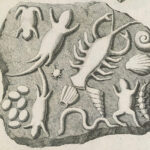
Roderick and Eckhart spent time meticulously hand-carving pieces of limestone into elaborate shapes: lizards, frogs, birds, insects, spiders sitting neatly in their webs, and plants, along with far stranger imagery, including depictions of the sun, moon, and comets, and inscriptions in Hebrew and Arabic script. Some of the Hebrew carvings even spelled out the name of God.
To get these forged stones in front of Beringer, the conspirators recruited three young men who worked for the professor collecting specimens around Mount Eibelstadt, just south of Würzburg: seventeen-year-old Christian Zänger and brothers Niklaus and Valentin Hehn, ages eighteen and fourteen. Whether the boys understood they were part of a deception or simply thought they were handing over genuine local curiosities remains debated, but regardless, they began delivering the carved stones to Beringer as authentic finds.
Beringer, delighted, kept digging — or rather, kept sending his diggers back for more. Over time, he acquired hundreds upon hundreds of these fabricated “fossils.” Given the era’s primitive and still-forming understanding of what fossils actually were, and the widespread belief that they might represent everything from divine signs to leftover evidence of Noah’s flood, Beringer convinced himself that these bizarre stones were nothing less than the work of God, placed in the earth as messages for humanity to discover.
Convinced he had made the discovery of a lifetime, Beringer set about publishing his findings in grand style. In 1726, he released a lavishly illustrated volume titled Lithographiae Wirceburgensis, filled with detailed engravings of the stones and his own theories about their divine origins. The book even featured an elaborate frontispiece incorporating the emblem of his patron, the Prince-Bishop, whom Beringer was eager to impress.
It did not take long for the deception to unravel. Some accounts suggest Beringer grew suspicious after finding a stone bearing his own name carved into it — a detail the hoaxers had apparently added, whether out of overconfidence or as a final, mocking flourish. Other historians believe the Prince-Bishop himself, aware that something was amiss, may have quietly signaled to Beringer that his prized discovery wasn’t what it seemed. Whatever tipped him off, Beringer realized, to his horror, that he had been thoroughly and publicly deceived — after his book was already in print and circulating.
Beringer did not take the humiliation quietly. He reportedly tried, unsuccessfully, to buy back and destroy as many copies of his own book as he could find. He then took his case to court, suing Roderick and Eckhart for their role in the deception. In April 1726, he won his case, and both men suffered real professional consequences: they lost their positions at the university, and Roderick was banished from Würzburg altogether, while Eckhart lost access to the library and archives his own historical research depended on, a blow that reportedly left his later work unfinished at his death.
But legal victory could not undo the damage to Beringer’s own name. Despite winning in court, his reputation as a scholar never recovered. His name became, fairly or not, a byword for gullibility, and the phrase “lying stones” followed him for the rest of his life and long after his death in 1738 or 1740, depending on the source.
Strangely, the story doesn’t fully resolve even today. Some later accounts, likely embellished over the centuries for dramatic effect, claim Beringer spent the remainder of his fortune trying to buy back every copy of his own book, only to still be haunted by its existence. What’s certain is that copies of Lithographiae Wirceburgensis survived, and both the book and roughly two dozen of the surviving carved stones themselves are still held in museum and university collections today, including at Oxford and London’s Natural History Museum, where they’ve occasionally been put on public display as a monument to one of history’s most audacious academic pranks.
Nearly three centuries later, Beringer’s Lying Stones remain a cautionary tale still taught in the history of science: a reminder of how easily confirmation bias, professional rivalry, and a hunger for recognition can combine to fool even a genuinely credentialed expert — and how, once a reputation is broken by public embarrassment, no courtroom victory can fully put it back together again.
In the summer of 1971, headlines around the world announced something extraordinary: a genuine…
On Halloween night in 1926, a wealthy, eccentric Toronto lawyer named Charles Vance Millar…
In September 1922, the streets of New York City erupted into eight days of…