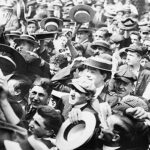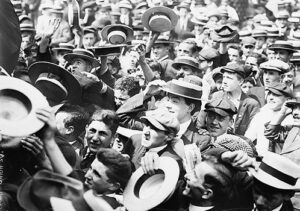
Hats Off — Whether You Like It or Not: The Bizarre Straw Hat Riot of 1922
— August 19, 2026In September 1922, the streets of New York City erupted into eight days of…

On Halloween night in 1926, a wealthy, eccentric Toronto lawyer named Charles Vance Millar suffered a fatal heart attack in his law office. He left behind no wife, no children, and no living relatives — but he did leave behind a will so strange it would dominate headlines, court dockets, and dinner-table conversations across Canada for the next decade. Millar’s final joke on the world became known as the Great Stork Derby, a bizarre real-life contest in which Toronto women competed to have as many babies as possible, all in pursuit of a small fortune.
To understand the will, it helps to understand the man. Millar was a highly successful lawyer, investor, and financier who built his fortune through breweries, real estate, and infrastructure investments, and he was known throughout Toronto as a shrewd operator with a taste for mischief. One of his favorite pastimes was reportedly leaving money lying on the sidewalk, then hiding nearby just to watch passersby agonize over whether to pick it up. He never married and had no children of his own, and by the time of his death he had amassed an estate worth roughly $322,000 — equivalent to several million dollars today.
Rather than let his fortune pass quietly to distant relatives or charity, Millar decided to use his will as one final, elaborate prank on the people of his city — and, some believe, as a pointed commentary on greed, the legal system, or even the era’s raging debates over birth control.
Millar’s will contained several odd bequests. He left shares in a jockey club to three men who were social and moral opposites of one another, purely to see how they would get along. He gave a Jamaican vacation home jointly to three men who despised each other, on the condition they had to share it. But the bequest that captured the public imagination — and consumed the bulk of his estate — was aimed squarely at the women of Toronto. The relevant clause promised the majority of his fortune to whichever Toronto mother had given birth to the greatest number of children in the ten years following his death, with the prize to be split evenly if there was a tie.
News of the unusual clause spread quickly, and what started as a legal curiosity soon became a genuine, if informal, competition. Newspapers began tracking birth announcements around the city, families found themselves in the spotlight, and the contest earned its enduring nickname: the Great Stork Derby.
The timing made the contest especially fraught. Much of the ten-year window overlapped with the Great Depression, a period when many Toronto families were already struggling to make ends meet. For some competing households, the enormous potential payout represented not just a windfall but genuine financial salvation, and several large families leaned into the competition in hopes of changing their fortunes.
The derby wasn’t without controversy or legal challenges. In 1932, partway through the contest, the Ontario legislature attempted to redirect the disputed inheritance money toward the University of Toronto instead, a move that provoked public outrage and only added more fuel to the story’s ongoing newspaper coverage. Distant relatives of Millar’s also tried more than once to have the will thrown out entirely so they could claim the estate for themselves. The legal wrangling eventually escalated all the way to the Supreme Court of Canada, which ultimately upheld the will’s unusual terms and allowed the contest to proceed to its conclusion.
There were also difficult, sometimes painful questions about how to count entries fairly. Newspapers at the time reported on cases involving stillbirths or infant deaths shortly after birth, and officials had to wrestle with how — or whether — those tragic outcomes should factor into the official tallies, adding a somber undercurrent to what was, on its surface, a strange and sensationalized spectacle.
When the ten-year window finally closed in 1936, the results were remarkably close. Four Toronto women were each found to have given birth to nine children over the decade, and the courts declared a four-way tie rather than crowning a single winner. In accordance with the terms of the will, Millar’s fortune was divided equally among all four families, each receiving a substantial sum that, for most, represented far more money than they had ever had at once. A few other women had made strong claims to even higher birth counts, but disputes over which births qualified under the will’s specific terms kept them from being declared co-winners.
The Great Stork Derby proved so captivating that it inspired an unlikely imitator. Toronto’s mayor at the time the derby began, Thomas Foster, was apparently taken enough with the concept that his own will, filed upon his death in 1945, established four separate smaller stork-derby-style contests of its own, rewarding Toronto mothers for large families over several subsequent multi-year periods.
Nearly a century later, the Great Stork Derby remains one of the strangest and most talked-about episodes in Canadian legal history — part practical joke, part social experiment, and part genuine lifeline for a handful of Depression-era families. As one contemporary news wire report summed it up when the contest finally ended in 1936, no one could quite agree on whether the whole affair had been ridiculous or tragic. In truth, it was very likely a little of both.
In September 1922, the streets of New York City erupted into eight days of…
For more than three centuries, one of the strangest psychological afflictions in European history…
In the misty pre-dawn hours of January 31, 1921, a Coast Guard surfman peering…