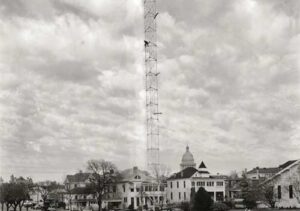
Chasing Bats with Brilliant Light: The Curious Story of the Great Moonlight Towers Experiment
— July 21, 2026In the late nineteenth century, cities across the United States embraced a dazzling new…

In the spring of 1954, residents of Seattle found themselves gripped by an unusual mystery that seemed ripped from the pages of science fiction. Across neighborhoods in Seattle and nearby communities, drivers began noticing tiny pits, scratches, and unexplained marks appearing on their car windshields. Within days, what started as scattered concern exploded into a regional panic known as the Great Seattle Windshield Pitting Epidemic—a bizarre episode of mass anxiety that remains one of America’s strangest forgotten mysteries.
The trouble appeared to begin in late March when motorists in areas south of Seattle started reporting mysterious damage to their windshields. Tiny chips and pits—small crater-like imperfections in the glass—appeared seemingly overnight. Soon, reports spread rapidly to nearby towns including Tacoma, Bellingham, and other parts of western Washington.
As concern mounted, theories flourished.
Some residents blamed radioactive fallout from nearby nuclear weapons testing. This was the height of the Cold War, after all, and fears of invisible contamination were deeply rooted in the public imagination. Others suspected cosmic dust, sand flea eggs, secret military experiments, or even sabotage by enemy agents. One particularly colorful theory suggested that vibrations from newly installed television transmitters were somehow damaging glass.
Newspapers eagerly reported the mystery, fueling public fascination and fear. Citizens examined their vehicles obsessively, often discovering tiny blemishes they had never previously noticed. Police departments became inundated with reports. In Seattle, concern grew so intense that Mayor Allan Pomeroy reportedly requested scientific investigation into the phenomenon.
Soon, experts from universities, local authorities, and even the military began examining damaged windshields. What they discovered proved both less dramatic and more revealing than the theories spreading through town.
Most of the “new” pitting, investigators concluded, was not new at all.
Cars naturally accumulate tiny chips and imperfections from years of normal driving. Gravel, dust, weather, and routine road wear leave marks so subtle that most drivers never pay attention to them. However, once media coverage highlighted the issue, people began scrutinizing their windshields in unusual detail. Suddenly, flaws that had gone unnoticed for years seemed alarming and mysterious.
Scientists examining vehicles found little evidence of anything unusual beyond ordinary wear and tear. In many cases, supposedly “fresh” damage showed signs of having developed gradually over long periods. Authorities concluded there was no epidemic—only heightened awareness amplified by fear and rumor.
The incident quickly became recognized as a textbook example of mass sociogenic illness, sometimes called mass hysteria. Much like outbreaks of phantom illnesses or scares over mysterious sounds, the windshield panic spread because people influenced one another’s perceptions. Once concern took hold, nearly every speck or scratch became evidence of the supposed phenomenon.
Within weeks, the frenzy subsided almost as suddenly as it had begun. Reports dwindled, public attention shifted elsewhere, and Seattle returned to normal. Yet the strange episode endured in psychological and sociological discussions as a fascinating example of how fear can spread through communities.
Today, the Great Seattle Windshield Pitting Epidemic is remembered less as a true mystery and more as a window into human nature. In an era shaped by atomic fears, rapid technological change, and Cold War paranoia, even tiny chips in a windshield could ignite extraordinary speculation.
Sometimes, the strangest mysteries are not about what happened—but why so many people believed something extraordinary had happened at all.
In the late nineteenth century, cities across the United States embraced a dazzling new…
In the summer of 1917, two young English girls produced a series of photographs…
In the autumn of 1869, laborers digging a well on a farm in upstate…