The Phantom Barber of Pascagoula: Mississippi’s Most Bizarre Midnight Mystery
— March 27, 2026In the quiet coastal town of Pascagoula, Mississippi, a strange and unsettling mystery gripped…

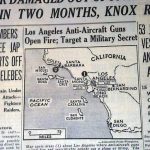
On February 25, 1942, just three months after Pearl Harbor, the city of Los Angeles woke to the scream of air-raid sirens and the thunder of anti-aircraft guns. Searchlights stabbed into the pre-dawn darkness, crisscrossing like dueling swords. For nearly an hour, more than 1,400 rounds of 12.8-pound shells ripped skyward. The target? Something the Army later described only as “unidentified aircraft.” To thousands of jittery civilians staring from rooftops and windows, it looked like the Japanese had finally come—until the smoke cleared and no enemy planes lay shattered on the ground. What remained was one of World War II’s strangest mysteries and a story that still fuels UFO lore eighty-four years later.
The panic had been building for weeks. On February 23, a Japanese submarine had surfaced off Santa Barbara and lobbed shells at an oil refinery. West Coast nerves were raw. Early on the 24th, radar stations near Los Angeles picked up an unexplained blip approaching from the sea. By 2:25 a.m. on the 25th, the 37th Coast Artillery Brigade was ordered to fire at will. Spotlights converged on a single, silvery object hovering motionless above Culver City. Witnesses described it as “saucer-shaped,” “oval,” or simply “huge.” Photographers from the Los Angeles Times captured the moment: beams of light forming a perfect pyramid around a glowing shape that refused to fall.
The barrage was chaotic and terrifying. Shrapnel rained down on neighborhoods from Santa Monica to Long Beach, smashing roofs and shattering windows. Five civilians died—not from enemy bombs, but from heart attacks and car crashes during the blackout. No bombs fell. No Japanese planes were ever found. The next day, Secretary of the Navy Frank Knox held a press conference and called the entire episode a “false alarm” caused by “war nerves.” The Army, however, was less certain. A later investigation suggested the object might have been a lost weather balloon or even a stray Japanese fire balloon, but the explanations felt thin even then.
The photographs told a different story. One front-page image showed searchlights locked on a bright, disc-like form that appeared untouched by the exploding shells. To a public already whispering about secret weapons and “foo fighters” seen by Allied pilots in Europe, the pictures looked like proof of something unearthly. Decades later, UFO researchers would point to the incident as one of the earliest mass sightings of what we now call unidentified aerial phenomena. Skeptics countered that wartime blackouts, spotlights, and mass hysteria had simply turned a stray blimp or cloud into an invading armada.
Whatever hovered over Los Angeles that night, the Battle of Los Angeles remains a perfect snapshot of a nation at war with itself as much as with its enemies. It revealed how fear can turn ordinary skies into battlegrounds and how quickly the human eye—and camera—can transform the unexplained into the extraordinary. Today the event is remembered not just as a footnote in military history, but as a cautionary tale: when the world feels under siege, even the stars can look like invaders. And sometimes the only thing that falls from the sky is our own certainty.
In the quiet coastal town of Pascagoula, Mississippi, a strange and unsettling mystery gripped…
In the late summer of 1835, readers of the New York Sun were treated…
In the sweltering summer of 1518, the streets of Strasbourg—then a prosperous free city…