Cavemen for the Cameras: The Strange Story of the Tasaday “Stone Age” Hoax
— August 21, 2026In the summer of 1971, headlines around the world announced something extraordinary: a genuine…

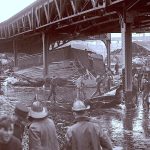
Just after 2 a.m. on Sunday, July 30, 1916, New Yorkers were jolted from sleep by what felt like an earthquake. The sky over New Jersey lit up with a blinding flash, followed by a thunderous roar that shattered windows from Times Square to Brooklyn and rattled buildings as far away as Philadelphia, ninety miles distant. The source was Black Tom Island—a small, man-made pier complex in New York Harbor, just off Jersey City and within sight of the Statue of Liberty and Ellis Island. There, more than two million pounds of TNT, dynamite, and artillery shells—destined for Britain and France—detonated in one of the largest non-nuclear explosions in history.
Black Tom had become America’s busiest munitions depot. Though the United States was officially neutral in World War I, American factories were supplying the Allies with vast quantities of war material. Freight cars loaded with explosives sat unguarded on the island’s piers while stevedores worked around the clock. Security was lax; the site was essentially a floating powder keg in one of the world’s busiest harbors.
The blast was no accident. German agents, operating under orders from Berlin’s naval intelligence service, had infiltrated the depot as part of a widespread sabotage campaign. Their goal was simple: stop the flow of American arms that were killing German soldiers on the Western Front. Years later, investigators identified key operatives—including Michael Kristoff, a Slovak immigrant, and German-American saboteurs Kurt Jahnke and Lothar Witzke—who used incendiary devices and timing mechanisms to ignite the cache. The first small fires were spotted around 12:30 a.m., but before firefighters could respond, the main explosion tore the island apart.
The human toll was immediate and tragic. At least seven people died, including three men on the island, a baby thrown from his crib in Jersey City, and others killed by flying debris. Hundreds more were injured. Shrapnel peppered the Statue of Liberty’s right side; the shock wave bent the torch arm and damaged its internal framework so badly that the torch has remained closed to visitors ever since. Property losses topped $20 million—roughly $590 million in today’s dollars. The Lehigh Valley Railroad, which owned the facility, lost entire warehouses and hundreds of rail cars.
At first, officials downplayed the incident to avoid inflaming public opinion. But persistent investigation by New York police, the Secret Service, and later the FBI’s predecessor revealed the German hand. In 1939 a claims commission at The Hague ruled Imperial Germany responsible; reparations were eventually paid after World War II.
The Black Tom explosion was a wake-up call. It exposed America’s vulnerability on its own soil, accelerated the push for stronger counter-intelligence, and helped tilt public sentiment against Germany. Just eight months later, the United States entered the war. Today, the former island is part of Liberty State Park—a quiet shoreline where joggers and families picnic, unaware that the ground beneath them once shook the nation awake to the realities of modern sabotage. The scars on the Statue of Liberty remain a silent reminder that even before America joined the fight, the fight had already come to its doorstep.
In the summer of 1971, headlines around the world announced something extraordinary: a genuine…
On Halloween night in 1926, a wealthy, eccentric Toronto lawyer named Charles Vance Millar…
In September 1922, the streets of New York City erupted into eight days of…