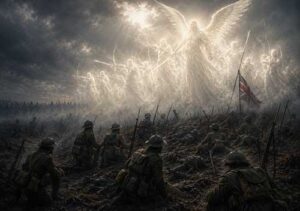
The Angel of Mons: Did Heavenly Warriors Save the British Army in World War I?
— July 23, 2026Among the many strange stories to emerge from the horrors of World War I,…

In the sweltering days of early July 1947, Boston found itself swept up in a nationwide frenzy that newspapers would later dub part of the “Great UFO Chase.” While the term evokes high-speed pursuits and screaming sirens, the reality in Beantown was a quieter but no less electrifying wave of mysterious aerial sightings that left residents scanning the skies, journalists scrambling for quotes, and officials scratching their heads. What began as a single pilot’s report in Washington state exploded into hundreds of accounts across the country, with Boston adding its own chapter to the unfolding mystery.
It all started on June 24 when private pilot Kenneth Arnold spotted nine shiny, crescent-shaped objects skipping across the sky near Mount Rainier like saucers skimming water. The press coined “flying saucers,” and within days the term was on everyone’s lips. By early July, reports flooded in from coast to coast. On Independence Day the sightings surged dramatically; they peaked around July 7 before tapering off amid a mix of genuine puzzlement, outright hoaxes, and everyday explanations such as weather balloons or aircraft. The timing could not have been more dramatic. World War II had ended just two years earlier, atomic bombs were fresh in the public mind, and the skies suddenly seemed full of the unknown.
Boston was no exception. Local newspapers, including the Boston Globe and Boston Traveler, carried multiple accounts between July 6 and July 9. On July 7, John Stewart of Dorchester, a neighborhood tucked inside the city proper, stepped outside with a friend and watched four silvery-white objects streak across the sky in tight formation. He estimated their altitude at around 5,000 feet and insisted they moved far faster than any plane he had ever seen. His companion agreed on the sighting but argued over the exact shade of the objects, a detail that only added to the sense of earnest confusion rather than fabrication. Other Boston reports trickled in the same week: bright discs hovering or darting at impossible speeds, sometimes in clusters, always silent. One Globe item from July 8 described similar objects over the city, while the Traveler carried parallel stories the day before. A final burst appeared on July 9. Even nearby Gardner, Massachusetts, logged a sighting on July 13. None involved literal chases by police cars or fighter jets; instead, the “chase” was the public and press racing to document and understand the phenomenon.
Residents reacted with a heady mix of wonder and worry. Some viewed the objects as experimental military craft, leftovers from wartime secrecy. Others whispered about visitors from other worlds, especially after the July 8 Roswell headlines declared that the Army had captured a “flying disc” in New Mexico, only to retract it the next day as a weather balloon. In Boston, amateur sky-watchers gathered on rooftops and along the Charles River. Radio stations read listener reports live. Civic leaders urged calm while privately wondering whether the sightings signaled Soviet reconnaissance or something far stranger. Hoaxes inevitably followed: teenagers launched pie tins tied to balloons, and one prankster even confessed to tossing aluminum discs from a plane. Yet many accounts, including Stewart’s, came from ordinary citizens with no apparent motive to invent tales.
The U.S. Army Air Force, still months away from becoming its own branch, took notice. Early investigations were cursory; most reports were filed and shelved. Project Blue Book, the more formal UFO study, lay years in the future. By mid-July the national wave had crested and receded. Boston’s newspapers moved on to local politics and the latest heat wave. The objects, whatever they were, simply stopped appearing, or at least stopped being reported with the same urgency.
Seventy-nine years later, the Boston sightings of 1947 remain a footnote in the larger 1947 flying-disc craze, yet they capture an innocent moment when the impossible felt suddenly plausible. No wreckage was recovered, no little green men emerged, and no government cover-up was ever proven in Massachusetts. Instead, the episode reflected postwar America’s blend of technological optimism and cosmic curiosity. Today, with modern drones, satellites, and renewed Pentagon interest in unidentified aerial phenomena, historians revisit these stories not as evidence of extraterrestrials but as a mirror of the era’s anxieties and hopes.
The Great UFO Chase never led to a dramatic arrest or landing on Boston Common. It left something more enduring: a collective memory that the sky above the Old North Church, the Common, and the harbor might still hold secrets. For a few summer evenings in 1947, ordinary Bostonians stood shoulder to shoulder, necks craned upward, united in the thrilling possibility that they were not alone.
Among the many strange stories to emerge from the horrors of World War I,…
Far to the south of Tokyo, beyond the bustle of Japan’s crowded coastline, lies…
In the summer of 1917, two young English girls produced a series of photographs…