Brazil’s Roswell: The Bizarre Varginha UFO Crash and Creature Encounter
— March 19, 2026In January 1996 the quiet Brazilian city of Varginha became the center of one…

On the morning of June 30, 1908, at approximately 7:17 a.m. local time, a cataclysmic explosion rocked the remote wilderness near the Podkamennaya Tunguska River in central Siberia. Equivalent to 10 to 15 megatons of TNT—roughly 1,000 times more powerful than the Hiroshima bomb—the blast is the largest impact event in recorded human history.
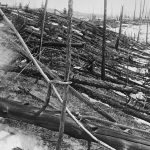
Eyewitnesses, including Evenki herders and Russian settlers hundreds of kilometers away, described a brilliant bluish-white fireball streaking across the sky, brighter than the sun. “The sky split in two,” recounted one survivor, S. Semenov, “and high above the forest, the whole northern sky appeared to be on fire.” A deafening series of explosions followed, accompanied by a scorching heat wave and powerful shockwaves that knocked people off their feet and shattered windows far and wide. In the epicenter, an area of over 2,150 square kilometers (830 square miles) of dense taiga forest was devastated. Approximately 80 million trees were flattened in a distinctive radial “butterfly” pattern, with central trees left standing but stripped bare, scorched by the intense heat.
The remote location in the East Siberian taiga meant few human casualties—estimates suggest up to three deaths—though thousands of reindeer perished. No impact crater was found, puzzling scientists for decades. The first major investigation came in 1927, led by Soviet mineralogist Leonid Kulik. His expeditions revealed the tree-fall patterns pointing to a central epicenter but no meteorite remnants on the surface. Later studies in the 1950s and 1960s uncovered microscopic extraterrestrial particles rich in nickel and iridium in the soil and peat bogs.

Today, the scientific consensus points to a meteor airburst: a stony asteroid approximately 50–60 meters (160–200 feet) in diameter exploding at an altitude of 5–10 kilometers. Traveling at around 15–30 km/s, it disintegrated violently in the atmosphere, releasing energy through a fireball and blast wave without reaching the ground. Some researchers favor a comet fragment, citing unusual bright night skies across Europe and Asia for days afterward, possibly from ice particles and dust.
The event had global repercussions. Seismic waves circled the Earth, detected as far as Washington, D.C., and atmospheric dust caused glowing skies and temporary ozone depletion. Modern simulations, informed by the 2013 Chelyabinsk meteor, confirm the airburst model.
The Tunguska Event serves as a stark reminder of Earth’s vulnerability to near-Earth objects. Such events occur roughly every few centuries to a millennium. As we monitor the skies with increasing vigilance through programs like NASA’s, the mystery of Tunguska underscores the importance of planetary defense against future cosmic threats. Though it devastated a wilderness, a similar blast over a major city would be apocalyptic.
In January 1996 the quiet Brazilian city of Varginha became the center of one…
On the night of August 15 1977 a radio telescope at Ohio State University…
On a chilly November morning in 1970, a 45-foot, eight-ton sperm whale washed ashore…