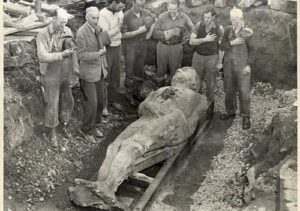
The Stone Giant That Fooled America: The Curious Hoax of the Cardiff Giant
— July 17, 2026In the autumn of 1869, laborers digging a well on a farm in upstate…

In the summer of 1917, two young English girls produced a series of photographs that appeared to show graceful fairies dancing among flowers in a quiet Yorkshire glen. What might have been dismissed as childish fantasy instead became an international sensation, convincing many respected figures that they were looking at genuine evidence of supernatural beings. The Cottingley Fairies remain one of the most famous photographic hoaxes of the twentieth century and a fascinating lesson in belief, imagination, and the persuasive power of photography.
The story began in the village of Cottingley, near Bradford, England. Nine-year-old Frances Griffiths and her sixteen-year-old cousin Elsie Wright often spent their afternoons exploring a small stream known as Cottingley Beck. Returning home wet and muddy, the girls frequently explained that they had been playing with fairies.
Their parents were skeptical.
To prove they were telling the truth, Elsie’s father allowed the girls to borrow his Midg quarter-plate camera. When the film was developed, the family was astonished. One photograph appeared to show Frances kneeling beside four winged fairies dancing in front of her. A second image depicted Elsie seated on the grass while a small winged gnome seemed to offer her flowers.
The photographs quickly attracted local attention.
Elsie’s father believed they were clever fakes, suspecting his daughter had somehow manipulated the images. Her mother, however, was more receptive to the idea that something extraordinary had been captured. The debate might have ended there had the photographs not come to the attention of members of the Theosophical Society, an organization deeply interested in mystical subjects and unseen spiritual realms.
Among those who examined the photographs was Edward Gardner, a leading Theosophist, who became convinced they were authentic. Gardner consulted photographic experts, who reported that there was no obvious evidence of double exposure or darkroom manipulation. While the analysts stopped short of declaring the fairies real, they concluded the negatives showed no signs of photographic tampering using the techniques available at the time.
The endorsement fueled public fascination.
The story reached an even larger audience through Sir Arthur Conan Doyle, the celebrated creator of Sherlock Holmes. Although famous for writing about the world’s greatest fictional detective, Doyle himself held a sincere belief in Spiritualism and life beyond death. He viewed the Cottingley photographs as potential evidence that unseen beings inhabited the natural world.
In 1920, Doyle published an enthusiastic article describing the photographs in The Strand Magazine. The response was overwhelming. Readers around the world debated whether the tiny winged figures were genuine nature spirits or simply an ingenious prank.
Seeking additional proof, Gardner supplied the girls with two more cameras and specially marked photographic plates that could not easily be substituted. The cousins soon returned with three additional fairy photographs. These new images showed fairy figures dancing, posing, and hovering around the girls in seemingly magical scenes.
To believers, the new photographs strengthened the case.
To skeptics, they merely demonstrated that the girls were consistent storytellers.
As the decades passed, the Cottingley Fairies became one of the most enduring mysteries in paranormal history. Even as photographic technology improved, many people continued to defend the authenticity of the images. Others pointed to the fairies’ remarkably stylized appearance, noting that they closely resembled illustrations found in popular children’s books of the period.
The mystery persisted for more than sixty years.
Finally, in the early 1980s, Frances and Elsie publicly acknowledged what many investigators had long suspected. The famous fairies had been simple paper cutouts copied from illustrations in a children’s book, carefully cut out, attached to hatpins, and positioned in front of the camera. Because photography in 1917 lacked the sophisticated forensic analysis available today, the deception had gone undetected by many experts.
The girls admitted that four of the five photographs had been staged.
Interestingly, Frances maintained throughout her life that the fifth and final photograph depicted a real fairy, a claim that continued to intrigue paranormal enthusiasts. Elsie, however, maintained that all of the images had been fabricated as harmless childhood fun that spiraled far beyond anything they had imagined.
The Cottingley Fairies left a lasting legacy that extends well beyond the hoax itself. The episode demonstrated how readily even educated observers can be influenced by hope, expectation, and the cultural climate of their time. Following the devastation of World War I, many people longed for evidence that the world still held mystery, beauty, and unseen wonders. In that emotional atmosphere, two imaginative girls with a camera and a few paper cutouts managed to convince much of the world that fairies had finally been photographed.
Today, the original photographs are preserved as historical curiosities rather than supernatural evidence. They remain among the most famous examples of photographic deception ever created and continue to fascinate historians, psychologists, photographers, and students of the paranormal. More than a century after they were taken, the Cottingley Fairy photographs remind us that sometimes the most enduring mysteries reveal less about the unseen world than they do about our own willingness to believe.
In the autumn of 1869, laborers digging a well on a farm in upstate…
In the spring of 1848, a series of mysterious knocking sounds inside a modest…
When people think of mysterious lake monsters, Scotland’s Loch Ness Monster usually comes to…