The Ghost That Led to a Murder: The Strange Hammersmith Ghost Trial of 1804
— July 13, 2026Few criminal cases in British history are as bizarre as the Hammersmith Ghost Murder….

Some of history’s deadliest natural disasters have come without warning, leaving behind little visible destruction but devastating loss of life. Such was the case on the night of August 21, 1986, when an invisible cloud silently rolled down the valleys surrounding Lake Nyos in northwestern Cameroon. By sunrise, entire villages had been wiped out. More than 1,700 people and thousands of livestock lay dead, victims of one of the strangest and most mysterious natural disasters ever recorded.
Unlike earthquakes, hurricanes, or volcanic eruptions, the Lake Nyos disaster produced almost no dramatic visual spectacle. There were no towering flames, rivers of lava, or collapsing buildings. Instead, an odorless, colorless cloud of carbon dioxide flowed silently across the countryside, suffocating nearly everything in its path.
Lake Nyos sits within the crater of an ancient volcano in the Oku Volcanic Field. Although the volcano itself had long been considered dormant, magma remained deep beneath the surface. Over many years, carbon dioxide from the Earth’s interior slowly seeped upward into the lake’s deep waters.
Because Lake Nyos is exceptionally deep, measuring more than 650 feet (200 meters), the cold, dense water near the bottom remained largely undisturbed. As a result, enormous quantities of dissolved carbon dioxide accumulated under pressure, much like carbon dioxide remains dissolved inside a sealed bottle of soda.
Scientists estimate that millions of tons of gas collected in the lake over decades.
Then something triggered its sudden release.
The exact cause remains uncertain. Researchers have suggested several possibilities, including a small landslide, volcanic activity beneath the lake, unusually heavy rainfall, or even strong winds disturbing the water. Whatever the trigger, the deep water suddenly rose toward the surface, where the reduced pressure allowed the dissolved carbon dioxide to escape explosively.
The process resembled opening a vigorously shaken bottle of carbonated soda, but on a gigantic scale.
As the gas burst from the lake, it created a towering fountain of water and sent an enormous cloud of carbon dioxide cascading over the crater rim. Because carbon dioxide is heavier than ordinary air, the cloud hugged the ground, flowing downhill through nearby valleys at speeds estimated to reach 30 to 50 miles per hour.
The sleeping villages below had no warning.
People simply stopped breathing.
Carbon dioxide does not poison the body directly. Instead, it displaces oxygen. Victims rapidly lost consciousness and suffocated within minutes. Many were found exactly where they had fallen asleep. Others collapsed while attempting to flee. Entire families perished together in their homes.
The gas cloud extended roughly 15 miles (25 kilometers) from the lake. By the time it dissipated naturally into the atmosphere, approximately 1,746 people had died. More than 3,500 cattle and countless other animals also suffocated.
Survivors described awakening to an eerie silence.
Birds no longer sang. Livestock lay motionless in fields. Entire villages appeared abandoned except for the bodies of neighbors and relatives. Many survivors suffered breathing difficulties, temporary paralysis, burns caused by exposure to the cold gas cloud, or lingering neurological symptoms.
Initially, authorities struggled to explain the disaster. Some feared a chemical weapon attack or a previously unknown volcanic eruption. Others believed poisonous gases had escaped from underground fissures.
Eventually, international teams of geologists, volcanologists, and chemists identified the true cause. They coined the term limnic eruption to describe the rare phenomenon in which dissolved gases suddenly erupt from deep lake waters.
Lake Nyos is not the only lake capable of such an event. Nearby Lake Monoun experienced a smaller carbon dioxide release in 1984 that killed 37 people. Scientists also identified Lake Kivu, located between Rwanda and the Democratic Republic of the Congo, as another lake containing dangerous quantities of dissolved gases, though it is far larger and supports millions of nearby residents.
In response to the Lake Nyos disaster, engineers developed an innovative solution. Beginning in 2001, they installed vertical degassing pipes extending into the lake’s deepest waters. These pipes allow carbon dioxide-rich water to rise gradually, where the gas escapes in a controlled manner before dangerous concentrations can accumulate.
The system functions continuously, reducing the likelihood of another catastrophic release.
Engineers have also monitored the stability of the lake’s natural volcanic dam. Because the crater wall has gradually eroded, concerns remain that its collapse could release massive amounts of water downstream, creating a devastating flood in addition to disturbing the lake itself.
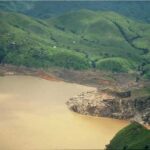
Today, Lake Nyos appears tranquil. Its blue waters reflect the surrounding mountains much as they did before 1986. Yet beneath that peaceful surface lies a reminder of the powerful geological forces still at work below the Earth.
The Lake Nyos disaster remains one of the deadliest and most unusual natural catastrophes in modern history. It revealed a little-known hazard hidden within certain volcanic lakes and demonstrated that nature’s most dangerous threats are not always accompanied by fire, smoke, or thunder. Sometimes, they arrive silently, invisibly, and without warning.
Few criminal cases in British history are as bizarre as the Hammersmith Ghost Murder….
When people think of mysterious lake monsters, Scotland’s Loch Ness Monster usually comes to…
When people think of World War II, they usually picture Allied nations united against…