Tiny Wings and Big Believers: The Cottingley Fairies That Captivated the World
— July 20, 2026In the summer of 1917, two young English girls produced a series of photographs…

There are not many stories in the world of the paranormal have sparked as much fascination and controversy as the case of the Pollock twins. Emerging from northern England in the 1950s, the story has been cited by believers as one of the strongest pieces of evidence for reincarnation, while skeptics argue that more ordinary explanations can account for the unusual events. More than seventy years later, the case continues to be discussed by researchers, psychologists, and those intrigued by life’s greatest mysteries.
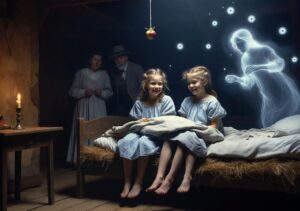
The story began in the town of Hexham, England. In 1957, two young sisters, Joanna and Jacqueline Pollock, were tragically killed in a traffic accident. Their deaths devastated their parents, John and Florence Pollock. John, in particular, held a strong belief in reincarnation and became convinced that his daughters would somehow return.
About a year later, Florence Pollock gave birth to twin girls, Gillian and Jennifer. From the beginning, the twins attracted attention because of several unusual characteristics. Jennifer was born with birthmarks that reportedly resembled scars and marks that Jacqueline had possessed. One mark was located on her forehead in a similar position to a scar Jacqueline had received after a childhood fall. Another birthmark appeared on her hip, where Jacqueline had also had a distinctive mark.
As the girls grew older, their parents noticed behaviors that seemed oddly familiar. According to reports, the twins displayed preferences and habits that resembled those of their deceased sisters. More strikingly, they allegedly recognized toys that had belonged to Joanna and Jacqueline, identifying them even though they had supposedly never seen them before.
The family also claimed that the twins made comments about places and events connected to the older sisters’ lives. On visits to locations the twins had never knowingly experienced, they reportedly appeared familiar with the surroundings. Some accounts describe the girls expressing fears related to automobiles, which believers interpreted as memories linked to the fatal accident.
These incidents attracted the attention of researchers interested in claims of reincarnation. Among the most notable was Ian Stevenson, a psychiatrist known for investigating cases in which children appeared to recall previous lives. Stevenson examined hundreds of such reports around the world and often cited the Pollock case as one of the more intriguing examples.
Believers argue that the combination of birthmarks, behavioral similarities, apparent memories, and recognition of personal objects presents a compelling case that cannot easily be dismissed. To them, the Pollock twins represent a rare instance in which detailed evidence points toward the possibility that consciousness survives death and can be reborn.
Skeptics, however, offer alternative explanations. They note that the surviving parents were grieving profoundly and may have unconsciously interpreted ordinary childhood behaviors through the lens of loss. Critics also point out that children are highly suggestible and can absorb information from conversations, family stories, and subtle cues without realizing it. In this view, the similarities between the twins and their deceased sisters may have been amplified over time as the story was retold.
As adults, Gillian and Jennifer reportedly did not continue to express memories of previous lives, a pattern seen in many alleged reincarnation cases. The unusual recollections faded, leaving behind only the mystery.
Whether viewed as evidence of reincarnation or as a fascinating example of psychology and human grief, the Pollock twins remain one of the most famous and debated cases in paranormal history. Their story continues to challenge assumptions about memory, identity, and the enduring question of what, if anything, happens after death.
In the summer of 1917, two young English girls produced a series of photographs…
In the spring of 1848, a series of mysterious knocking sounds inside a modest…
In the summer of 1858, the heart of the British Empire found itself overwhelmed…