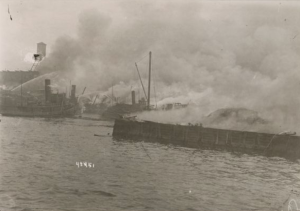
Black Tom Inferno: The 1916 Sabotage That Shook New York Harbor and America’s Neutrality
— April 10, 2026Just after 2 a.m. on Sunday, July 30, 1916, New Yorkers were jolted from…

On a small island off the coast of Nova Scotia, Canada, lies one of the world’s most persistent enigmas. For more than two centuries, the Oak Island Money Pit has lured treasure hunters with promises of vast riches while delivering nothing but frustration, floods, and tragedy. The story began in 1795 when teenager Daniel McGinnis spotted a strange depression in the ground near an old oak tree. Joined by friends John Smith and Anthony Vaughn, he dug what would become known as the Money Pit. At two feet they hit flagstones. Every ten feet they encountered oak platforms. Tool marks lined the walls. By thirty feet they stopped, spooked by what seemed too deliberate to ignore.
Word spread fast. In 1802 the Onslow Company pushed deeper, hitting ninety feet and discovering layers of charcoal, putty, and coconut fiber alongside a mysterious inscribed stone. Then seawater flooded the shaft. Later groups, including the Truro Company in 1849, uncovered what appeared to be a sophisticated flood tunnel system connected to Smith’s Cove. Every serious attempt ended the same way: water rushed in, shafts collapsed, and progress halted. Early drillers reported striking metal objects and even what felt like chests far below, yet nothing ever surfaced intact.
The island earned a grim reputation. A so called curse claimed that seven men must die before the treasure would reveal itself. At least six deaths have been documented, from a 1861 boiler explosion to drownings and toxic fumes in 1965 that killed four men in one day. Despite the dangers, investors kept coming. Franklin D. Roosevelt joined an expedition in 1909. Later teams drilled boreholes, built causeways, and poured dye into the ground to trace the water sources. Modern science suggests some flooding may result from natural glacial formations rather than man made traps, but that explanation has done little to dampen enthusiasm.
Theories about the pit’s contents have multiplied. Some point to pirate Captain Kidd burying his loot. Others link it to Knights Templar hiding the Holy Grail or the Ark of the Covenant. A few suggest Shakespeare manuscripts proving Francis Bacon authored the plays, or even Marie Antoinette’s lost jewels. Coconut fiber, once used to line ships, hints at transatlantic origins. Artifacts recovered over the years include old coins, tools, and parchment fragments, yet no treasure trove has ever emerged.
Today the search continues under brothers Rick and Marty Lagina, who purchased a controlling interest in 2006. Their efforts star in the long running History Channel series The Curse of Oak Island, now in its thirteenth season as of 2026. The show follows the team as they employ ground penetrating radar, massive excavators, and scientific analysis to probe new areas around the original pit site, which itself has been lost to collapses. Recent seasons have uncovered more intriguing finds such as medieval era coins and wooden structures, but the big payoff remains elusive.
Oak Island Tours holds the treasure trove license, and exploration is regulated by provincial law. The Laginas and their partners have invested millions, turning the island into a high tech archaeological site. Skeptics argue the pit may have been nothing more than an old sinkhole or a colonial era works project. Believers insist something extraordinary waits below the bedrock.
After 230 years the Money Pit still guards its secret. Each new season of digging brings fresh clues and renewed hope, yet the treasure, if it ever existed, refuses to surrender. For dreamers and doubters alike, Oak Island stands as proof that some mysteries are more valuable unsolved. The next big breakthrough could lie just one careful excavation away. Or it may remain forever buried, a testament to human persistence in the face of the unknown.
Just after 2 a.m. on Sunday, July 30, 1916, New Yorkers were jolted from…
In the summer of 1587, 115 English men, women, and children stepped ashore on…
Few maritime mysteries have captured the imagination quite like the story of the Mary…