The Kentucky Meat Shower: When Flesh Fell From a Clear Blue Sky
— March 6, 2026In the rolling hills of Bath County, Kentucky, an ordinary spring day in 1876…

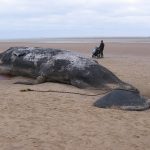
On a chilly November morning in 1970, a 45-foot, eight-ton sperm whale washed ashore near Florence, Oregon, kicking off one of the decade’s most bizarre news events. What started as a simple beach cleanup quickly escalated into a spectacular, blubber-filled disaster that would become legendary.
The massive carcass beached itself on November 9. Within days, the decomposing giant began reeking, drawing crowds of curious spectators while posing a growing health hazard. At the time, Oregon’s coastal beaches fell under the jurisdiction of the State Highway Division. Officials needed a plan—fast.
Assistant District Highway Engineer George Thornton consulted U.S. Navy experts and decided on a dramatic solution: dynamite. Treating the whale like an oversized road obstacle, the team figured blasting it into small pieces would let seagulls, crabs, and the tide handle the rest. On November 12, crews carefully packed roughly half a ton of explosives inside the carcass.
Hundreds gathered a quarter-mile away for the show, including KATU-TV reporter Paul Linnman and cameraman Doug Brazil. At 3:45 p.m., the fuse was lit.
The beach erupted in a towering geyser of sand, blubber, and whale parts. Instead of neatly disintegrating, enormous chunks of flesh rocketed hundreds of feet into the air—some traveling up to 800 feet. Blubber rained down like macabre confetti, forcing spectators to sprint for cover. One hefty slab smashed through the roof of a parked car parked well outside the “safe” zone. The air thickened with the unmistakable stench of exploded marine mammal.
No one was seriously hurt, but the blast didn’t fully solve the problem. Large sections of the whale remained, forcing workers to bury what the explosion left behind. Thornton later deadpanned to reporters that the operation “went just exactly right”—except for the flying debris, of course.
The story could have faded as a quirky local tale, but it exploded into pop-culture immortality decades later. Humorist Dave Barry’s 1990 column resurrected the grainy footage, turning it viral long before the internet. The original KATU report has since racked up tens of millions of views online. Today, Florence proudly owns its weird history with an “Exploding Whale Memorial Park,” an annual celebration, and even commemorative plaques.
In an era of gas shortages, disco fever, and Watergate, the exploding whale stood out as pure, absurd Americana. It remains a hilarious reminder of well-intentioned government ingenuity gone hilariously wrong—and a cautionary tale about what happens when you try to solve a whale-sized problem with too much boom. Oregon didn’t just blow up a whale that day; it blew the lid off ordinary news forever.
In the rolling hills of Bath County, Kentucky, an ordinary spring day in 1876…
On the morning of June 30, 1908, at approximately 7:17 a.m. local time, a…
To many people lizards are weird no matter what species you happen to be…