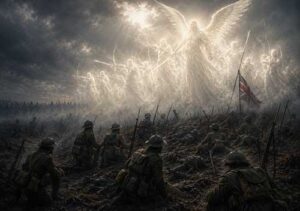
The Angel of Mons: Did Heavenly Warriors Save the British Army in World War I?
— July 23, 2026Among the many strange stories to emerge from the horrors of World War I,…

In the summer of 2008, a bizarre photograph taken on a quiet beach in Montauk ignited one of the internet’s strangest modern mysteries. The image showed a grotesque, hairless creature with a beak-like snout, exposed teeth, and oddly shaped limbs lying lifeless in the sand. Almost overnight, it became known as the “Montauk Monster,” inspiring theories ranging from escaped laboratory experiments to undiscovered species and government conspiracies.
The mystery began in July 2008 when photographs of the strange carcass reportedly taken at Ditch Plains Beach near Montauk began circulating online. In the images, the creature appeared unlike anything many people had seen before. It seemed to possess leathery skin, clawed feet, and a narrow jaw that looked disturbingly bird-like. The lack of obvious fur only heightened the bizarre appearance.
At first, local curiosity quickly escalated into national fascination.
Because Montauk sits near the infamous former military installation known as Camp Hero State Park—a site long surrounded by conspiracy theories involving secret experiments—speculation exploded. Some suggested the carcass had escaped from a hidden government laboratory conducting genetic testing. Others tied it to rumors surrounding the legendary “Montauk Project,” an alleged secret Cold War operation supposedly involving mind control, time travel, and bizarre experiments, despite little credible evidence supporting such claims.
The internet, then rapidly becoming a breeding ground for viral mysteries, amplified the story enormously. Message boards, blogs, and news outlets debated the creature’s identity. Was it a mutant? A previously unknown marine animal? A victim of toxic contamination? Some even joked that it resembled a real-life movie monster washed ashore from the deep.
Adding to the intrigue, witnesses offered conflicting stories about what happened to the carcass. Some claimed it disappeared mysteriously before scientists could examine it. Others said an unknown person took possession of the remains. No verified specimen was ever formally analyzed by major scientific institutions, leaving only photographs behind to fuel endless debate.
Yet as the excitement grew, zoologists and wildlife experts offered far less sensational explanations.
One leading theory suggested the “monster” was simply the decomposed remains of a raccoon. At first glance, this sounded absurd to many observers, but experts explained that decomposition in water can dramatically alter an animal’s appearance. Fur often slips away after prolonged exposure to moisture, revealing skin and bone structures that appear shockingly unfamiliar. Missing tissue around the mouth can also create the illusion of a beak-like snout.
Others proposed the carcass belonged to a dog, coyote, or opossum altered by decay and scavenger activity. Some researchers pointed to the shape of the paws and skeletal proportions as evidence favoring a raccoon explanation.
Still, skeptics questioned whether the teeth and jaw truly matched any common animal. The absence of definitive testing meant no explanation could ever be proven conclusively.
Part of what made the Montauk Monster story so compelling was timing. By 2008, online culture had become increasingly fascinated with viral mysteries and conspiracy theories. A strange photograph combined with secrecy and missing evidence created the perfect recipe for speculation.
Today, the Montauk Monster remains an enduring internet-era legend—a curious blend of biology, rumor, and imagination. Most experts lean toward the theory that it was an ordinary animal distorted by decomposition, yet uncertainty lingers.
Perhaps that lingering uncertainty explains why the image still fascinates. On a lonely stretch of New York shoreline, something strange washed ashore—and whether monster or misunderstood raccoon, it briefly convinced the world that mystery still lurked beneath the waves.
Among the many strange stories to emerge from the horrors of World War I,…
Far to the south of Tokyo, beyond the bustle of Japan’s crowded coastline, lies…
In the summer of 1917, two young English girls produced a series of photographs…