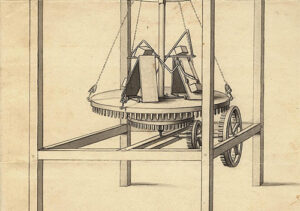
The Machine That Fooled a City: Charles Redheffer’s Perpetual Motion Con
— August 25, 2026For centuries, inventors chased one of the most tantalizing impossible dreams in mechanics: a…

When most people think of military balloons used during World War II, Japan’s Fu-Go balloon bombs often come to mind. Far less well known is Operation Outward, a daring British campaign that launched nearly 100,000 unmanned balloons across the North Sea toward Nazi-occupied Europe. Carrying incendiary devices and long steel wires designed to short-circuit power lines, these simple weapons proved surprisingly effective and demonstrated that sometimes the simplest technology could produce remarkable results.
Operation Outward began in March 1942, at a time when Britain was searching for inexpensive ways to harass Germany without risking aircraft or aircrews. The idea originated with Britain’s Petroleum Warfare Department, which recognized that prevailing winds frequently blew eastward from England toward continental Europe. If balloons could ride these winds, they might drift deep into enemy territory carrying destructive payloads.
The balloons themselves were simple but cleverly engineered. Most were made of lightweight latex and filled with hydrogen gas. Depending on their mission, they carried either incendiary bombs weighing several pounds or long trailing steel wires intended to snag high-voltage electrical transmission lines.
The wire-carrying balloons were particularly ingenious. As the balloon descended, the wire could bridge electrical conductors, creating massive short circuits. In some cases, the resulting surge tripped protective equipment. In others, the electrical arc damaged transformers, transmission equipment, or generating stations.
Incendiary balloons had a different mission. Their small firebombs were intended to ignite forests, farmland, factories, warehouses, or military facilities after descending into German-controlled territory. While many landed harmlessly, enough reached valuable targets to keep German civil defense authorities constantly occupied.
Launching the balloons required surprisingly little effort. They were released from several sites along England’s east coast whenever weather forecasts indicated favorable winds. Thousands could be launched during a single operation. Once airborne, they required no guidance, fuel, or radio communications. The atmosphere did the rest.
Between March 1942 and September 1944, Britain launched approximately 99,000 balloons, making Operation Outward one of the largest balloon warfare campaigns ever conducted.
Initially, German authorities struggled to understand the strange aerial visitors. Reports poured in describing mysterious balloons drifting silently overhead before descending across occupied Europe. Military personnel were dispatched to recover them, while electrical crews investigated unexplained power failures and fires.
One of the campaign’s most notable successes occurred in July 1942, when a wire-carrying balloon struck a high-voltage transmission line near Leipzig. The resulting electrical fault reportedly caused a fire that damaged equipment at the Böhlen power station, temporarily disrupting electricity to nearby industrial facilities. Although the physical damage was limited, the incident demonstrated that even inexpensive balloons could threaten critical infrastructure.
The balloons also created an ongoing logistical burden. German authorities were forced to devote manpower, vehicles, and technical personnel to locating, recovering, and disposing of thousands of drifting balloons. Every reported sighting demanded attention because it was impossible to know whether a balloon carried explosives, incendiaries, or merely a dangling wire.
Not every balloon reached its intended destination. Some drifted into neutral countries, while others descended harmlessly into the sea. Weather remained an unpredictable factor throughout the campaign, occasionally sending balloons far off course.
British officials considered the operation highly cost-effective. A balloon cost only a tiny fraction of what was required to build and operate a bomber aircraft, yet each launch forced Germany to expend valuable resources in response. Unlike conventional bombing raids, Operation Outward involved no aircrews who might be shot down or captured.
As Allied air superiority increased during 1944 and conventional bombing campaigns intensified, the military value of balloon attacks gradually declined. Operation Outward officially ended in September 1944 after more than two years of continuous launches.
Although often overshadowed by larger wartime operations, historians now recognize Operation Outward as an innovative example of asymmetric warfare. It combined basic meteorology, simple engineering, and creative military thinking to produce a weapon that was inexpensive, difficult to defend against, and psychologically unsettling.
The campaign also highlighted the importance of infrastructure as a military target long before modern discussions of critical infrastructure protection became common. Rather than seeking dramatic explosions, many balloons aimed to interrupt electrical networks and force the enemy to divert resources away from the front lines.
Today, Operation Outward remains one of World War II’s lesser-known stories. Overshadowed by massive bombing raids and famous battles, the humble hydrogen balloon rarely receives the attention it deserves. Yet for more than two years, thousands of these silent travelers drifted across the skies of occupied Europe, carrying fire, disruption, and uncertainty. Their legacy serves as a reminder that in wartime, even the simplest ideas can become surprisingly effective weapons.
For centuries, inventors chased one of the most tantalizing impossible dreams in mechanics: a…
In 1725, a respected physician and professor near the German city of Würzburg believed…
In the summer of 1971, headlines around the world announced something extraordinary: a genuine…