Britain’s Secret Balloon Blitz: The Forgotten Operation Outward Campaign of World War II
— July 8, 2026When most people think of military balloons used during World War II, Japan’s Fu-Go…

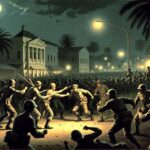
When people think of World War II, they usually picture Allied nations united against the Axis powers. Yet on the night of November 26 and into the early hours of November 27, 1942, thousands of American and Australian servicemen found themselves fighting each other in the streets of Brisbane, Australia. The confrontation, later known as the Battle of Brisbane, became one of the largest and most embarrassing clashes between Allied forces during the war.
By late 1942, Australia had become a vital staging area for the Pacific campaign. Following Japan’s rapid advance through Southeast Asia and the bombing of Darwin, tens of thousands of American troops poured into the country. General Douglas MacArthur had established his Southwest Pacific headquarters in Brisbane, transforming the city into a bustling military hub.
The sudden influx of American servicemen created unexpected tensions.
Although the Australians welcomed American assistance, cultural differences soon became apparent. American troops generally received higher pay, enjoyed better rations, and had access to equipment that seemed luxurious compared to what Australian soldiers had been issued. They often carried chocolate, cigarettes, chewing gum, and other goods that were difficult for Australians to obtain due to wartime rationing.
American uniforms also attracted attention. Their sharp appearance and abundance of supplies made them popular with local civilians, especially young women.
Many Australian servicemen grew increasingly resentful. They jokingly referred to the Americans as “overpaid, oversexed, and over here,” while some Americans viewed their Australian counterparts as undisciplined or rough around the edges. Though much of the rivalry remained good-natured, occasional fights in pubs and dance halls became common.
The situation finally exploded on Thanksgiving Day, November 26, 1942.
The spark occurred outside the American Post Exchange, or PX, located on the corner of Queen and Creek Streets in downtown Brisbane. The PX served only U.S. personnel, and Australian soldiers were prohibited from entering. An argument broke out when an Australian serviceman became involved in an altercation near the entrance with an American military policeman.
As the dispute intensified, a crowd quickly gathered.
Within minutes, hundreds of Australian and American servicemen were exchanging punches. Military police attempted to restore order, but their efforts only inflamed the situation. Reinforcements arrived, and the crowd swelled into the thousands as curious civilians looked on.
The fighting spread through nearby streets. Participants armed themselves with whatever they could find, including belts, bottles, clubs, and lengths of wood. At one point, an American military policeman retrieved a shotgun from a nearby vehicle.
The presence of the firearm dramatically escalated the confrontation.
During the chaos, Australian soldier Private Edward Webster was fatally wounded by shotgun fire. Several others suffered gunshot injuries, while hundreds of participants sustained cuts, bruises, broken bones, and other injuries from the hand-to-hand fighting.
Authorities eventually managed to disperse the crowds, but the unrest was not entirely over. The following evening, another confrontation erupted in Brisbane before military leaders were finally able to restore order.
The official casualty figures remain somewhat uncertain, but historians generally estimate that well over 300 servicemen from both countries were injured during the disturbances.
Both the Australian and American governments moved quickly to minimize publicity surrounding the riot. Wartime censorship restricted newspaper coverage, and military officials were eager to avoid damaging morale or suggesting divisions within the Allied partnership. As a result, many people outside Australia remained unaware of the incident for years.
Following investigations, commanders on both sides recognized that the violence had not been caused by a single event but rather by months of accumulated frustration. Differences in military discipline, pay scales, living conditions, and social opportunities had steadily fueled resentment. Efforts were made to improve relations through better coordination between military authorities and increased recreational opportunities for both American and Australian personnel.
Fortunately, the Battle of Brisbane proved to be an isolated episode rather than the beginning of a lasting conflict. American and Australian forces continued to fight side by side throughout the Pacific War, participating together in major campaigns across New Guinea, the Philippines, and other theaters. The cooperation between the two nations ultimately became one of the defining partnerships of the Allied victory against Japan.
Today, the Battle of Brisbane stands as a fascinating reminder that even allies united by a common cause can experience moments of intense friction. Far from weakening the Allied war effort, the incident demonstrated the challenges of bringing together hundreds of thousands of young servicemen from different cultures under the extraordinary pressures of global war.
Although overshadowed by famous battles against the Axis powers, the streets of Brisbane briefly became the scene of an extraordinary and ironic confrontation in which Allied soldiers turned their anger on one another rather than the enemy. More than eighty years later, the riot remains one of the most unusual and little-known episodes of World War II.
When most people think of military balloons used during World War II, Japan’s Fu-Go…
When people think of attacks on the continental United States during World War II,…
Few American ghost stories are as unusual or as well documented as the legend…